
Content

As discussed in the previous step, journal entries are used to record a business transaction and subsequently a change in the accounting equation. Please complete this on loose leaf or a different blank piece of paper. For the year 2016, bad debts expense were $7,500 and accounts amounting to $6,400 were written-off. Sage 50cloud is a feature-rich accounting platform with tools for sales tracking, reporting, invoicing and payment processing and vendor, customer and employee management. When you’re ready to use T-accounts, you can use them separately, in order to view journal entry details, or you can enter the transaction directly into your journal. Draw a bank account for George’s catering business and obtain the closing balance of the bank account.
Let’s look at the journal entries for Printing Plus and post each of those entries to their respective T-accounts. Let’s look at one of the journal entries from Printing Plus and fill in the corresponding ledgers. Cash was used to pay for salaries, which decreases the Cash account. Cash is an asset, which in this case is increasing. The dollar value of the debits must equal the dollar value of the credits or else the equation will go out of balance.
Buying An Asset On Account
On April 19, he identified the following transactions. Prepare the necessary journal entries after reviewing the transactions and post them to necessary T- Accounts. Accounts Payable AccountAccounts payable is the amount due by a business to its suppliers or vendors for the purchase of products or services. It is categorized as current liabilities on the balance sheet and must be satisfied within an accounting period.
- Revenue accounts increase with credit entries, so credit lawn-mowing revenue.
- “T” accounts vertically divide page of the ledger in two equal halves.
- Accounts Payable recognized the liability the company had to the supplier to pay for the equipment.
- All debits fall on the left side of the T-account and credits fall on the right side, eventually balancing out at the bottom of the ledger.
- In simplistic terms, this means that Assets are accounts viewed as having a future value to the company (i.e. cash, accounts receivable, equipment, computers).
- No matter what type of accounting you are using, you can use a T-account as a visual aid in recording your financial transactions.
Below is a short video that will help explain how T Accounts are used to keep track of revenues and expenses on the income statement. Learn more in CFI’s free Accounting Fundamentals Course. Double entry is an accounting term stating that every financial transaction has equal and opposite effects in at least two different accounts. Choose the Budget Journals button to see the journal entries for the selected detail account.
Reviewing Detail Account Balances
This creates a liability for the company, Accounts Payable. This liability increases Accounts Payable; thus, Accounts Payable increases on the credit side. Salaries are an expense to the business for employee work. This will increase Salaries Expense, affecting equity. Expenses increase on the debit side; thus, Salaries Expense will increase on the debit side. Cash is decreasing because it was used to pay for the outstanding liability created on January 5. Cash is an asset and will decrease on the credit side.

It also makes it quite easy to keep track of all the additions or deductions in an account. The debit side is on the left of the t-account and the credit side is on the right. A bookkeeper can quickly spot an error if there is one and immediately fix it with the help of this visualization. The balance at the end of the period is called the closing balance. Also, note that last year’s closing balance becomes this year’s opening balance.
Finance Your Business
On a blank piece of paper, draw your three T accounts, making them large enough you can write numbers on either side of the T. To explain T accounts, let’s first take a look at a simple example of how they work. If you would like to see what it looks like to move journal postings into a general ledger in Excel, watch this additional video. You have the following transactions the last few days of April.
Your general ledger provides the necessary information to create financial statements, like your business balance sheet, cash flow statement, and income statement. In turn, your financial statements can give you a clear snapshot of your business’s finances. To post to general ledger, you must use double-entry bookkeeping. With double-entry bookkeeping, you record two entries for every transaction using debits and credits. You paid “on account.” Remember that “on account” means a service was performed or an item was received without being paid for. You made a purchase of gas on account earlier in the month, and at that time you increased accounts payable to show you had a liability to pay this amount sometime in the future. You are now paying down some of the money you owe on that account.
Accountingtools
A T-Account is a visual presentation of the journal entries recorded in a general ledger account. This T format graphically depicts the debits on the left side of the T and the credits on the right side. This system allows accountants and bookkeepers to easily track account balances and spot errors in journal entries. This use of the terms can be counter-intuitive to people unfamiliar with bookkeeping concepts, who may always think of a credit as an increase and a debit as a decrease.
If you enter a transaction on the credit side in one account, there will be a corresponding entry on the debit side to another account. In this way, debits and credits increase or decrease the corresponding accounts to keep the books balanced. Let’s take an example to understand how entries are recorded in T accounts. The company receives a $10,000 invoice from the landlord for the July rent payment which is due.

For each account you see the period-to-date , quarter-to-date , and year-to-date budget balance. Choose the Detail Accounts button to review the detail balances that roll up into the summary balance for the selected period and detail budget.
Transaction #1
Through the sale, you increase your Revenue account through a credit. And, increase your Accounts Receivable account through a debit. Equity is the difference between your assets and liabilities. This means you have an increase in the total amount of gas expense for April. Colfax Market is a small corner grocery store that carries a variety of staple items such as meat, milk, eggs, bread, and so on. As a smaller grocery store,Colfax does not offer the variety of products found in a larger supermarket or chain.
And for a review of the most common journal entries, see the lesson on basic accounting journal entries. In this example, assume a business that sells computer hardware and accessories to individuals and other businesses records its sales in a T-account. The bookkeeper organizes all the business’ accounts receivable transactions into credits and debits for the quarter, including payments customers haven’t made yet. The bookkeeper debits completed payments and credits the business inventory account, then highlights incomplete payments for further evaluation. As a young accountant I had to determine the effect of a new FASB standard on my employer’s financial statements.
It increases liability, expenses, and owner’s equity accounts and decreases asset and prepaid expense accounts. This can cause a company’s general ledger to not balance. If you specified a balance-level reporting currency in Step 2, you must choose Total to view total translated balances. t account example If you choose any other Currency Type, the balances are retrieved from the source ledger that was used to enter journals. Use the T Accounts window to view General Ledger journals or subledger accounting entries in a graphical T-account format, displayed in the T Accounts window.
How In The World Do You Post Journal Entries To The General Ledger?
A number of T accounts are typically clustered together to show all of the accounts affected by an accounting transaction. The debit entry of an asset account translates to an increase to the account, while the right side of the asset T-account represents a decrease to the account. This means that a business that receives cash, for example, will debit the asset account, but will credit the account if it pays out cash. For example, while analyzing total consolidated sales, you may want to determine how much each subsidiary contributed to the total amount. Simply drill down from the consolidated sales balance to any subsidiary sales account balance. From there, you can view account details and journals. If you need still more information, drill down further to the subledger transactions that contributed to your total consolidated sales balance.
- Generally, businesses list their accounts by creating a chart of accounts .
- But once you get the hang of it, recording journal entries will be less intimidating.
- If at any point the sum of debits for all accounts does not equal the corresponding sum of credits for all accounts, an error has occurred.
- But before transactions are posted to the T-accounts, they are first recorded using special forms known asjournals.
- A T-account consists of a left side and right side, and the name of the account sits at the top of a T-account.
For example, say your chart of accounts lists cash as account number 101. When you receive a cash payment, you use cash for the T-account title and 101 for the T-account number. Earning a revenue of $10,500 will increase the asset account balance.
Sample Problem On T Account
You cannot include variances in your Account Inquiry if you choose to inquire on all currencies. For more information on secondary ledgers, see Secondary Ledgers. To create a view, choose the Create Period Listing View button or the Create Period Trend View button. These buttons display after you choose the New Search button.
Enterprise Multi-cloud Strategies Won’t Work With Legacy Tech – Here’s Why – Toolbox
Enterprise Multi-cloud Strategies Won’t Work With Legacy Tech – Here’s Why.
Posted: Wed, 01 Dec 2021 14:30:30 GMT [source]
Choose the T Accounts or Activity Summary button to open the related window. Choose the More button to see additional fields that you can use to refine your query.
Likewise, accounts with a credit balance, like liabilities, will always increase when another credit is added to the account. Furthermore, the number of transactions entered as the debits must be equivalent to that of the credits. A T-account is an informal term for a set of financial records that uses double-entry bookkeeping. The term describes the appearance of the bookkeeping entries. To view summary account balances, your data access set must provide read access to the parent value, such as “T”, which is used in the summary account.
Yh if it’s deleted it will say “this twitter has been suspended” for example @kilzys and if u deactivate the account it’ll say it doesn’t exist
— Kllzys (@Kllzys12) November 28, 2021
But once you get the hang of it, recording journal entries will be less intimidating. A T-account isn’t a type of account in your books, but rather a device you use for visualizing how to record an accounting transaction. Prepare the necessary journal entries for these four transactions.
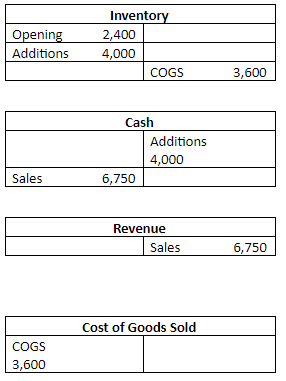
Choose All Currencies to view balances for all ledgers and ledger currencies assigned to this ledger set. If your ledger set contains multiple ledgers, each with a different ledger currency, All Currencies allows you to view balances across all ledgers in the ledger set.
The Options, T Accounts, and Activity Summary windows are all linked. From any of these windows you can get to the other two by choosing the appropriate button.
Author: Maggie Kate Fitzgerald